
Overview: David L., an experienced investor with an engineering and fund management background, struggled with fear-based trading and inconsistent results. Despite his intelligence, his performance was limited by risk aversion and outcome-focused thinking. But through our Mindset and Process Program, David shifted from fear-driven decisions to disciplined, process-based execution.
By embracing structured investment plans, intentional measurement, journaling, and personal accountability, he adapted the trading process needed to achieve consistency. This case study highlights how mastering psychology and process can transform trading stress into calm confidence that achieves profitability.
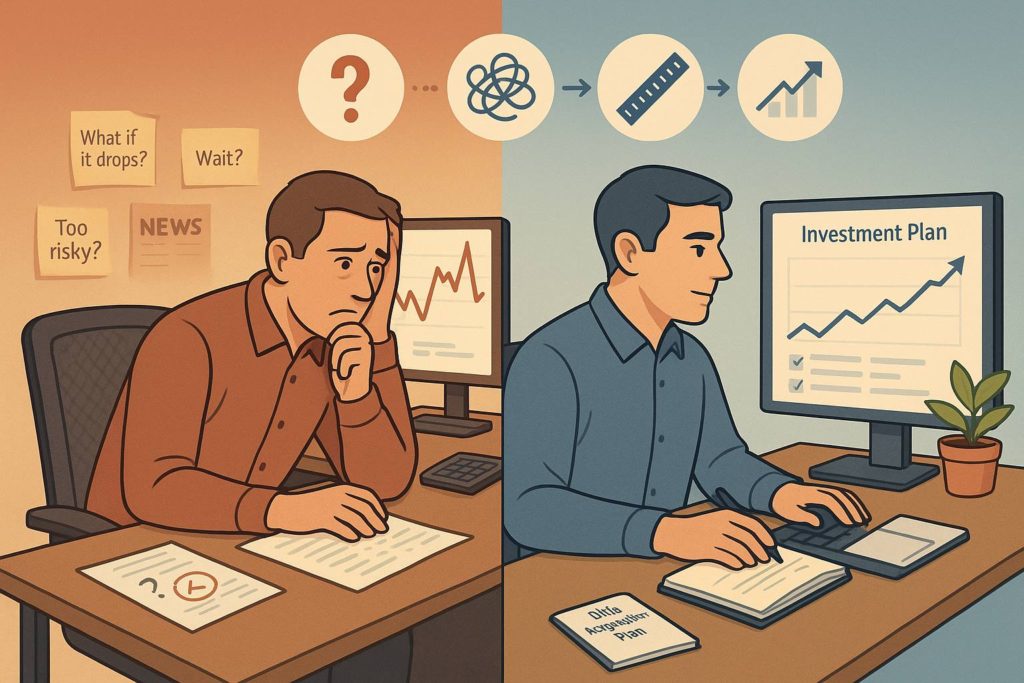
David L. is an experienced investor with prior experience managing his own investment fund. Despite his intelligence and technical understanding of the markets, he faced fear and risk aversion, causing him to under-invest and limit his results.
This trading psychology case study explores how a structured Mindset and Process Program helped David shift from outcome-focused thinking to process-driven execution. You will learn how a disciplined mindset, intentional measurement, and personal accountability can transform fear-based trading into consistent, confident investing.
The Central Challenge: Psychology Over Intellect
Why Intelligence Can Become a Liability in Trading
David describes the market as independent of intellect, stating,
“I consider myself intelligent, but the market is anything but; it’ll do what it does.”
Yet his analytical mindset often clashed with the unpredictable nature of markets, leading to hesitation and inconsistent decisions. Despite having strong technical skills, his intelligence alone could not overcome emotional biases or fear-driven behavior.
The 80/20 Psychological Principle
For David, 80–90% of trading success is psychological, with only 10–20% relying on technical skill. He reflects,
“Virtually anything you do… the doing bit is by comparison relatively easy.”
This principle emphasizes that mindset forms the foundation for all decisions, and mastering psychological resilience is essential for consistent execution.
Why Technical Skills Fail Without Mindset
David stresses that no amount of analysis can compensate for poor mental frameworks.
“No amount of analysis is going to get you to where you need to be without fixing your mindset in the first place,” he explains.
Even highly skilled investors fail if fear, overthinking, or risk aversion dominates their decision-making.
The Paralyzing Effect of Fear
Fear-Based Under-Investment
Despite making timely, profitable trades, David’s fear often led to keeping too much capital in cash.
“For a good part of the last 12 months… I haven’t had enough of my capital invested because I’ve been more concerned about trying to protect what I’ve got than trying to grow it,” he admits.
This focus on capital preservation limited his growth opportunities and overall performance.
Outcome-Focused Thinking
David was often obsessed about the potential negative outcomes, rather than trusting his system. He explains,
“I’m focused on the outcome and what might happen and all the fear associated with it.”
This emotional forecasting led to decision paralysis, preventing him from making disciplined actions and thus consistent returns.
Risk Aversion → Poor Returns
A critical insight David learned is that avoiding risk directly limits potential returns.
“The extent to which you avoid risk is the extent to which you effectively don’t get the returns,” he notes.
By focusing too heavily on protecting capital, he inadvertently sacrificed opportunities to achieve profitability.
Key Learnings & Path Forward
Process Over Outcome
The main shift in David’s trading journey involved moving from result-oriented thinking to process-based execution. He now prioritizes becoming a “consistent peaceful investor” by following a defined system and detaching his emotions from individual trade outcomes. This approach allows him to transform trading stress into calm confidence.
The Power of a “No Wiggle Room” System
Inspired by Mark Douglas, David emphasizes the importance of rigid rules in reducing psychological conflict.
“When I know my system has no wiggle room, that’s simple but exactly what it needs to be,” he explains.
This helps him maintain discipline even during emotionally charged market moments.
Intentional Measurement & Journaling
David recognized that poor tracking of trades, emotions, and triggers led to repeated mistakes.
“I don’t measure it to the extent that I should, so I don’t have a definitive answer,” he admits.
The program has taught him to journal intentionally, enabling data-driven reflection and continuous improvement.
Strategic Planning Beats Random Analysis
Random analysis leads to inconsistent results, but creating a structured Investment Plan and Skills Acquisition Plan provides clarity.
David shares, “Without the other two, the analysis becomes random.”
Strategic planning allows him to learn more intentionally and avoid aimless experimentation.
Radical Personal Accountability
David learned that ultimate responsibility for financial outcomes lies with the individual.
“No one’s going to be more interested in my money than me,” he says.
Taking ownership has reinforced his discipline and commitment to his structured investment approach.
Evaluation of the Mindset & Process Program
Program Structure
The program’s repetitive structure has reinforced learning, allowing David to internalize key concepts.
“It’s repetitive, which is good… You introduce topics but then repeat them in slightly different ways, and it makes a big difference,” he notes.
Repeated Engagement
Revisiting the program has allowed him to gain new insights, especially as his perspective and priorities shift over time. He recommends leaving space between viewings to maximize benefits.
Integration of Experts
Incorporating teachings from Mark Douglas, James Clear, and Tony Robbins helped David connect concepts across psychology, habits, and decision-making. He praises the program for not assuming it has all the answers, but instead building on proven methods.
Practical Tools
Structured tools like the Skills Acquisition Plan, Investment Plan, and Portfolio Manager have been instrumental. These resources have provided a framework for disciplined execution, measurement, and evaluation.
Ongoing Guidance & Accessibility
Weekly updates and market presentations ensure David stays current and engaged. He appreciates the accessibility of the creators:
“I’ve always had good support; the accessibility you have is great.”
The Real Value: A Catalyst for Growth
The program does not give results directly; it provides a framework for self-directed improvement.
David explains,
“The value is not what you give, it’s more what I produce out of that.”
Through structured coaching, measurement, and disciplined process execution, he has overcome fear-based trading and established consistent, disciplined investment habits.
Conclusion
David L.’s journey shows that intelligence alone is not enough for trading success. Through the Mindset and Process Program, he moved from fear-driven under-investment to disciplined execution, journaling, and personal accountability.
By embracing structured rules and focusing on process rather than outcomes, David now trades with confidence and consistency. His story is an example to traders struggling with fear-based decisions, and how they can achieve similar transformations by adopting mindset-focused coaching and systematic processes.
Learn how the Mindset and Process Program can help you overcome fear-based trading, build discipline, and achieve consistent results. Join our LTTP program today and start transforming your trading mindset and process.
Frequently Asked Questions
1. What is fear-based trading, and how does it affect investors?
Fear-based trading occurs when decisions are driven by the desire to avoid losses rather than to grow capital. It often leads to under-investment, missed opportunities, and inconsistent results, as seen in David L.’s early experience.
2. How does the Mindset and Process Program overcome fear in trading?
The program focuses on building a structured system, reinforcing psychological resilience, and creating good habits. By emphasizing process over outcomes and providing practical tools, it helps traders act confidently and consistently regardless of market conditions.
3. Why is personal accountability important in trading?
David L. realized that no one cares more about your capital than you do. Trading success depends on you taking full responsibility for your decisions, outcomes, and consistent execution of your system without reliance on external factors.
4. Can technical skills alone guarantee trading success?
No. Even advanced technical skills cannot compensate for a poor mindset and fear-driven behaviors. David’s case demonstrates that consistent profitability comes from combining analysis with psychological mastery and a disciplined process.
5. What practical tools does the program provide to improve trading discipline?
The Mindset and Process Program offers tools like the Investment Plan, Skills Acquisition Plan, Portfolio Manager, and structured journaling exercises. These tools track progress, identify behavioral triggers, and enforce rigid, no-wiggle-room execution.