
Overview: Anger (and its cousins fear, frustration, and revenge) narrows your thinking, impairs control, and pushes you into riskier decisions that break your rules. A sustainable trading “rhythm” comes from one mechanical process, risk management, and a simple in-the-moment reset routine: breathe (down-shift your nervous system), name the state, return to the rule. Build this into a habit so the edge, not your mood, drives results.
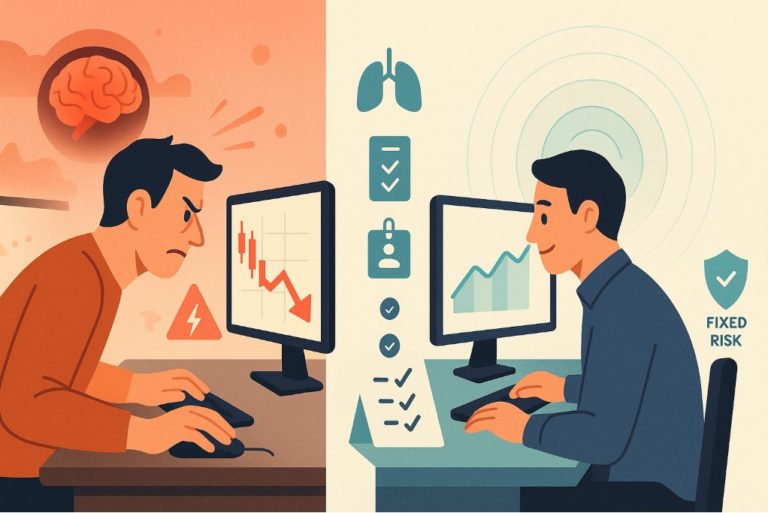
Markets are probabilistic. And in this environment, your edge plays out over a series of trades, not one. But when anger hits, this simple truth easily gets drowned out. You move stop-loss markers, chase entries, “get even,” and hand back hard-won gains.
This article explains what anger does to the brain, why it wrecks execution, and how a simple, repeatable plan gets you back to your natural trading rhythm: calm, mechanical, and consistent.
Why does anger break your trading rhythm?
Anger is a fast, body-first state, which means it hits the physiology before the thinking brain has a chance to weigh in: heart rate rises, muscles prime, breathing shortens, and the brain shifts toward threat detection.
In other words, the body reacts first, and the mind tries to catch up. That’s why anger feels sudden, and why it can override the calm, rule-based processes trading depends on.
The result? Tunnel vision, impulsive choices, and broken rules. The exact opposite of calm execution.
Neuroimaging studies show that anger and reactive aggression reduce connectivity between the medial prefrontal cortex and the amygdala. This weakens top-down regulation right when you need it most.
Anger also skews risk perception. Incidental anger tends to increase risk-seeking and flatten how we process trades, making it a fertile ground for revenge trading and “double or nothing” behavior.
Key takeaway
Anger doesn’t just feel bad; it changes the control system you rely on to execute your plan consistently.
What is a trader’s “natural rhythm” and why does it matter?
Your rhythm is the set of behaviors you can do on autopilot: run the scan, size the position by rule, place the stop, journal, and review weekly. When you’re in rhythm, decisions feel simple because they’re pre-decided.
Breaks in rhythm usually show up as:
- Moving a stop “just this once.”
- Adjusting a position size mid-trade because you “know” it’ll bounce.
- Skipping the journal when you’re annoyed.
- Re-testing the system during a drawdown instead of following it.
The fix is to restore the state quickly and return to the checklist.
Key takeaway
Rhythm = rules you can run without debate. Protect the rhythm, and the rhythm protects your equity curve.
How exactly does anger change trading decisions?
Three mechanisms show up again and again:
- Cognitive narrowing. Acute stress impairs working memory, attention, and response inhibition. These are the core skills you need to follow trading rules consistently. When these are impaired, you miss obvious information and over-weight the recent candle.
- Reward bias and impatience. Under stress, the brain overvalues immediate rewards and underweights long-term outcomes. This is a classic example of “take the quick scalp” or “yank the stop” behaviour.
Risk-seeking after loss. Anger and perceived losses push many people towards higher risk. This can heighten risk propensity and regret, which is exactly the cycle that fuels revenge trading.
Key takeaway
In anger, you’re neurologically set up to break your own rules.
Can you prevent anger from hijacking execution?
You can’t prevent every spike, but you can shorten and soften it. The most reliable lever is the body.
Downshift your nervous system with breathing. Slow, controlled breathing increases parasympathetic tone and helps restore cognitive control. Meta-analytic and clinical reviews show that breathing practices reduce stress arousal and support clearer thinking. Try a 4-second inhale, 6-second exhale, for two minutes.
Here are some things you can do:
Name the state.
When you acknowledge what you’re feeling (“I’m angry,” “I’m tense”), you interrupt the autopilot reaction. This short labeling step lowers emotional intensity and helps the thinking part of the brain come back online.
Return to the rule.
Once you’ve created that pause, go straight to the script you trust: read the exit/stop rule exactly as written. This anchors your next action to the plan you built when you were calm — not the emotion you’re feeling now.
If anger is chronic or intense…
That’s a sign the issue isn’t just trading stress. In that case, proven anger-management strategies or professional guidance can help you build better regulation outside of the market, which makes in-the-moment trading decisions easier.
Key takeaway
Breath → label → rule. A 4-second inhale and a 6-second exhale reset is usually enough to protect the next decision.
What simple routine keeps you in rhythm during the trading day
Use a two-part “in-trade” routine and a short closing ritual.
In-trade routine (before placing any order)
- Run the checklist.
- Confirm: entry signal present, risk unit set, stop placed at entry, and position size matches the risk.
This locks you into mechanical decisions before emotion has a chance to show up.
- Confirm: entry signal present, risk unit set, stop placed at entry, and position size matches the risk.
- One breath cycle (4-in, 6-out × 3).
- This settles the nervous system so you’re entering the trade from a neutral state, not an activated one.
- Commit line: “I accept the predefined loss.”
This removes the emotional charge from the outcome. You’re agreeing upfront not to fight the stop.
Then place the order.
If an emotion spike hits mid-trade
- Pause the mouse: Interrupt the impulse.
- Use the 4-second inhale, and 6-second exhale technique: This pulls the system out of the fight-or-flight pattern.
- Name the state: “Angry,” “tense,” “frustrated.” This step reduces emotional intensity.
- Read the exit rule: Re-anchor to the plan written when you were calm.
- Execute the rule exactly: This sequence protects you from the classic anger moves: moving the stop, chasing, or “getting even.”
Closing ritual
- Journal the trade: Document what happened and whether you followed the rule. This turns emotion into data.
- Record WR/PR and adherence: You’re training your brain to value process, not mood or single outcomes.
- Write one sentence for tomorrow: “Run the scan, trust the stop.” This creates continuity and keeps your mental state anchored to routine rather than frustration or fear.
Key takeaway
Tiny rituals hard-wire the rhythm so you don’t rely on willpower.
How do you build long-term immunity to “anger trading”?
You won’t be immune, but you can become resilient:
- One mechanical edge. Consistency starts with a verified structure, not mindset alone.
- Weekly review on the vital few metrics. Track Win Rate (WR), Profit Ratio (PR), expectancy, max drawdown, and adherence.
- Judge results by series, not single trades. Expectancy unfolds over 50–100 trades. That defuses the urge to “fix” one trade with a worse one.
- Keep tweaks out of live trading. If you want to change a rule, test it in a sandbox first.
Neuroscience is clear: even mild, uncontrollable stress can rapidly impair prefrontal abilities. Reducing decision load and standardizing steps keeps your “thinking brain” online more often.
Key takeaway
Structure reduces stress; less stress preserves control; control preserves the edge.
Does anger always make trading worse?
Anger is a signal that something matters to you. In a real-world threat, a fast, forceful response can be useful. But markets aren’t life-or-death; they’re math-and-process. That’s why, in the financial landscape, anger tends to push risk-seeking and snap judgments: poor matches for rule-based systems.
Respect the emotion, but don’t let it run the trade.
If anger keeps pulling you off your rules, LTTP gives you the structure and support to break that cycle. We’ll set your risk unit, install a mechanical rule set, and coach you through a weekly review rhythm that stabilizes your decision-making, especially after losses, when anger usually strikes hardest.
By the end of the first month, you won’t be guessing or reacting; you’ll be running a process that protects you from emotional impulses and keeps you in rhythm.
Frequently Asked Questions
Can breathing really change decisions?
Yes. Slow breathing shifts autonomic balance towards parasympathetic tone and supports clearer cognition. It’s simple, fast, and effective.
How long until I feel more consistent?
Many traders feel calmer within a week of using a checklist + breathing reset. Measurable consistency usually shows up over one to three months, an ideal timeframe for a series of trades to show their edge and for weekly reviews to become a habit.
Is anger the only emotion that hurts trading?
No. Fear and anxiety can also distort choices and impair prefrontal control. What matters is having a state reset and a rule to return to.
What if I keep breaking rules?
Shrink risk to the smallest unit, reduce the number of decisions per session, and add accountability (study group/coach). If anger is chronic or severe, seek support; evidence-based strategies help.